
In October, the Catholic Church in the United States celebrates Respect Life Month, and the first Sunday of October is designated as Respect Life Sunday.
For resourses to aid you in participating in Respect Life Month, Click here
Youth LEAD
“Believe what you see, see what you believe and become what you are: the Body of Christ.” – St. Augustine+
High School Youth Leadership Retreat at Camp Stella Maris: November 20-22 CLICK HERE
Youth LEAD (Leadership Evangelization And Discipleship) is a weekend leadership retreat experience for high school youth (grades 9-12) sponsored by the Office of Evangelization & Catechesis. The experience shares practical skills and a clear vision of leadership that allows youth to follow the call of our Church to be the Body of Christ in the world.
From the Desk of Father John
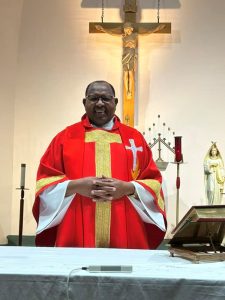
Ordained priesthood in the church: Reflections on a 40th anniversary
Has the celebration of the Holy Mass become routine? Is your day centered around it? Pope Saint John Paul II has said, “If the Eucharist is the center and summit of the Church’s life, it is likewise the center and summit of priestly ministry.” Our hope is to inspire your celebration of the Holy Mass to be the center and summit your active priestly mission. Forty years ago, October 18th, 1986, on the Feast of St Luke, I knelt before the bishop, felt the weight of his hands on my head, and promised to give my life away. If you had told that young, idealistic man what the next 40 years would look like, he would have been both terrified and utterly awed. On this, my Anniversary, I find myself looking back not at a career, but at a long, beautiful, and deeply humbling confession of life.
The greatest privilege of a priest’s life is his proximity to the human soul. For forty years, I have been a custodian of people’s secrets, their deepest joys, and their most agonizing sorrows. I have poured the waters of baptism over the heads of infants, and I have held the hands of those taking their very last breaths. There is a profound, almost crushing beauty in being allowed into those moments. I have stood at the altar during weddings, looking at young love full of hope, and I have sat in the confessional, weeping in the dark with those who felt entirely broken and beyond redemption.
As I look at my aging hands today—hands that have lifted the chalice thousands of times—I am filled with an overwhelming sense of gratitude. I have seen miracles of grace that no book could ever contain. I have seen hard hearts melt, fractured families heal, and despair turn into quiet hope. I entered the priesthood thinking I was going to change the world for God, but I reach this milestone realizing that God used the world, and the beautiful people of my parishes, to change me. Until today, nothing can separate my priesthood from the sacrifice and the celebration of the Eucharist—it has been a transfiguring experience in the journey of my priesthood. The prayer of Pope Paul VI has been an inspiration to every mass that l have celebrated: he prayed a beautiful prayer each time before he celebrated Mass, “Lord, grant me the grace to celebrate this Mass as if it were my first Mass, my only Mass, and my last Mass.” The Holy Eucharist is the most visible sign of God’s love for each of us. Jesus loves us so much that he cannot leave us. “And know that I am with you always until the end of time” (Matthew 28: 20). Every time we celebrate the Eucharist together, we are transformed into being gifts for other. This transformation does not lead to the abandonment of or withdrawal from the community, but engagement with it—seeking to build a community of prayers, a community of service, a community that knows how to break and share, a community that endures together in times of suffering, a community that know how to gather round the table and share the Eucharistic meal, a community that upholds and protect the Christian values of peace and justice, and a community that cares for its sacred spaces, cares for its children, cares for the vulnerable, and cares for its senior members of its community. Have we truly become such a Eucharistic Community! If I could speak to that young priest standing at the altar forty years ago, I would simply tell him: “Do not be afraid. The road is long, and you will stumble, but His grace really is sufficient
This is my 6th year as your priest here in Holy Family Catholic Community! I cannot claim to be a perfect priest. I acknowledge that I have my own faults and failures, but I am sure of one thing, that God is still calling me to build something with you in our lives, relationship and community until the very last day. During this time, we have shared our experiences, for me it has been an abundance of experiences–they have been joyful; they have been few sad moments; they have been exciting and creative; they have been a few frustrating occasions; they have been all sorts. However, we celebrated, prayed, rejoiced, cried, mourned and grown. In all these experiences the voice of Christ continued to ask “Do you love Me.” Sometimes, it is difficult and scary when we count the cost of love, and were it not of God grace and your care, how could l have survived? To answer yes to Christ call, mean to live our love in this world, “Feed my sheep,” “Tend my Flock,” “Feed my sheep.” This makes love a celebration. I am happy to be a priest and happy to be HERE at the Holy Family Catholic Community as your pastor. However, on the level of friendship, I hope that our love will continue to grow. I know that l am a human being capable of wounding and hurting even those that l love though not intended. l ask for forgiveness and much more the gift of your prayers as my life continues to unfold.
40 years have gone by quickly. I think it’s because I have been happy, fulfilled, and supported by so many others every step of the way. I’ve lived with great brother priests. I’ve been inspired by wonderful sisters. I’ve been lifted up through the experiences of families. I’ve found great happiness in performing Baptisms, Marriages, Reconciliation, First Communions, Confirmations, and funerals for those I love and serve.
Thank you, Lord, for the gift of the priesthood, and for calling me to this great opportunity. Thank you for helping me say “yes” as often as I could. And thank you for the blessing of so many people I call friends, a big family of God’s children whom I love and who love me. God put me exactly where I was supposed to be and with the people I was supposed to accompany.
I look forward to many more years of commitment to the Lord in his vineyard and whatever God calls me to do.
God’s still in control, and I wouldn’t want it any other way. Fr. John
Mission Statement
To live the Great Commandment
Jesus said to him, ‘You shall love the Lord, your God with all your heart,
with all your soul, and with all your mind.’ And
‘You shall love your neighbor as yourself.’
Matthew 22: 37-38